The story behind the stage
Taira no Masakado: the shrine's rebel
Who Taira no Masakado was, why a tenth-century rebel became a god at Kanda Myojin, and how his legend feeds the samurai show on the shrine's grounds.
Book the samurai night ↗Quick answer
Taira no Masakado was a tenth-century warrior from eastern Japan who led the first recorded uprising against the court in Kyoto, claimed the title of New Emperor and was killed in 940. His head was buried near today's Otemachi, and the spirit people feared became a protector. Kanda Myojin enshrines him as one of its three deities, and the show on its grounds draws on his legend.
Who Masakado was
Masakado was a provincial magnate and warrior based in eastern Japan, a descendant of the Taira clan, which traced its line to Emperor Kanmu. As a young man he went to the capital, Heian-kyo, and served a powerful regent, but he failed to win court rank or a significant office. Back in the east, feuds over land and marriage pulled him into a run of battles in the 930s. Sources disagree on the exact cause of the conflict, so any single explanation is a simplification.
The uprising and the title
In 939 Masakado attacked a government outpost in Hitachi Province and captured the governor. He then took Shimotsuke and Kozuke provinces and claimed the title of Shinno, the New Emperor. The court in Kyoto put a bounty on his head. He was killed in 940 at the Battle of Kojima by his cousin Taira no Sadamori and Fujiwara no Hidesato, and his head was taken to the capital. Historians treat his revolt as the first recorded uprising against the central government.
From rebel to guardian
Masakado's head is said to have reached Shibasaki, a fishing village on the edge of what became Edo, where it was buried. The mound survives in Otemachi, in the business district. Locals who respected his defiance, and feared his curse, came to honour him, and he is counted among the Three Great Onryo of Japan, vengeful spirits who are also worshipped. Kanda Myojin's own account says disasters near the mound led a travelling monk, Shinkyo, to console his spirit, and that Masakado was enshrined at the shrine in 1309.
Masakado at Kanda Myojin
Kanda Myojin enshrines three deities: Daikoku, Ebisu and Masakado. Warriors revered the shrine, and it says Tokugawa Ieyasu had prayers for victory said here before the battle of Sekigahara in 1600. When the Tokugawa rose to power the shrine was moved, in 1616, to its present site, which it describes as protecting a demon gate of Edo Castle. In the Meiji era Masakado was moved out of the main hall for a time, and he has been enshrined there again since.
The legend on stage
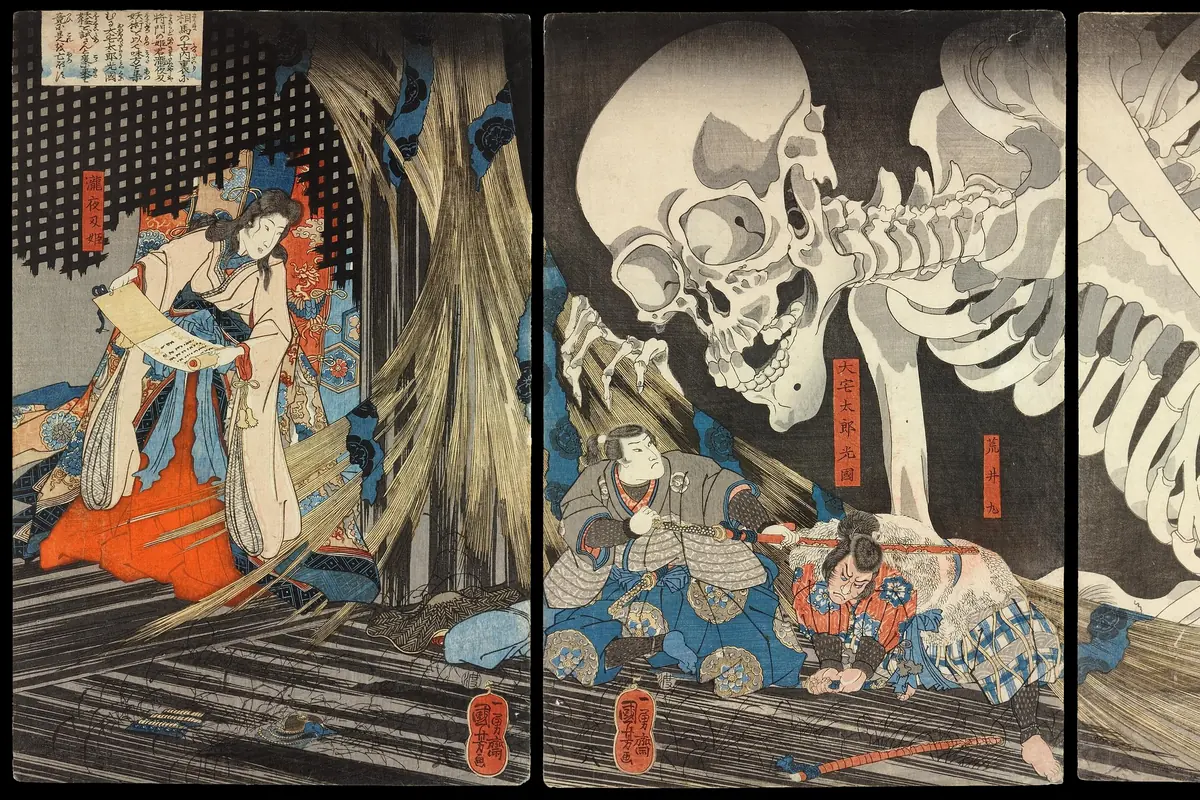
The show's own story page retells the legend as drama. After Masakado dies, his daughter Takiyasha-hime turns herself into a demon to avenge him, and the court sends a half-demon warrior, Yashamaru, to hunt her down. The two fall in love, and Masakado's spirit appears to guide the living towards reconciliation. The daughter is a figure of legend, and Utagawa Kuniyoshi's triptych of about 1844 shows her summoning a giant skeleton, a print that shaped the popular image of the gashadokuro, a skeleton spectre.
What to take from it
The show is entertainment, not a history lesson, and parts of it can change without notice, so you cannot book by chapter. Treat the Masakado story as a legend with a real man at its centre. The shrine's history and Wikipedia agree on the outline, his death in 940 and his enshrining at Kanda, but differ on details such as when he returned to the main hall after the Meiji removal.
Read next: Samurai night show Tokyo: what to book
Frequently asked questions
Was Masakado a real person?
Yes. He died in 940. An account of his life, the Shomonki, is believed to have been completed as early as the 940s, and historians treat his revolt as the first recorded uprising against the court.
Does the show tell his story?
The show's own site publishes a chapter built on his legend, but parts of the show can change without notice, so the chapter on your night is not guaranteed.
Where is his burial mound?
In Otemachi, in central Tokyo. The shrine's pages say the mound is a Tokyo-designated cultural property.
Sources